Postdoctoral Research Associate - AI for Science.
Research project in a nutshell
Title: Substitution of numerical fluid mechanics models by deep learning models. Applications to vascular pathologies
Winner of the A*MIDEX 2021 Interdisciplinarity call for projects !
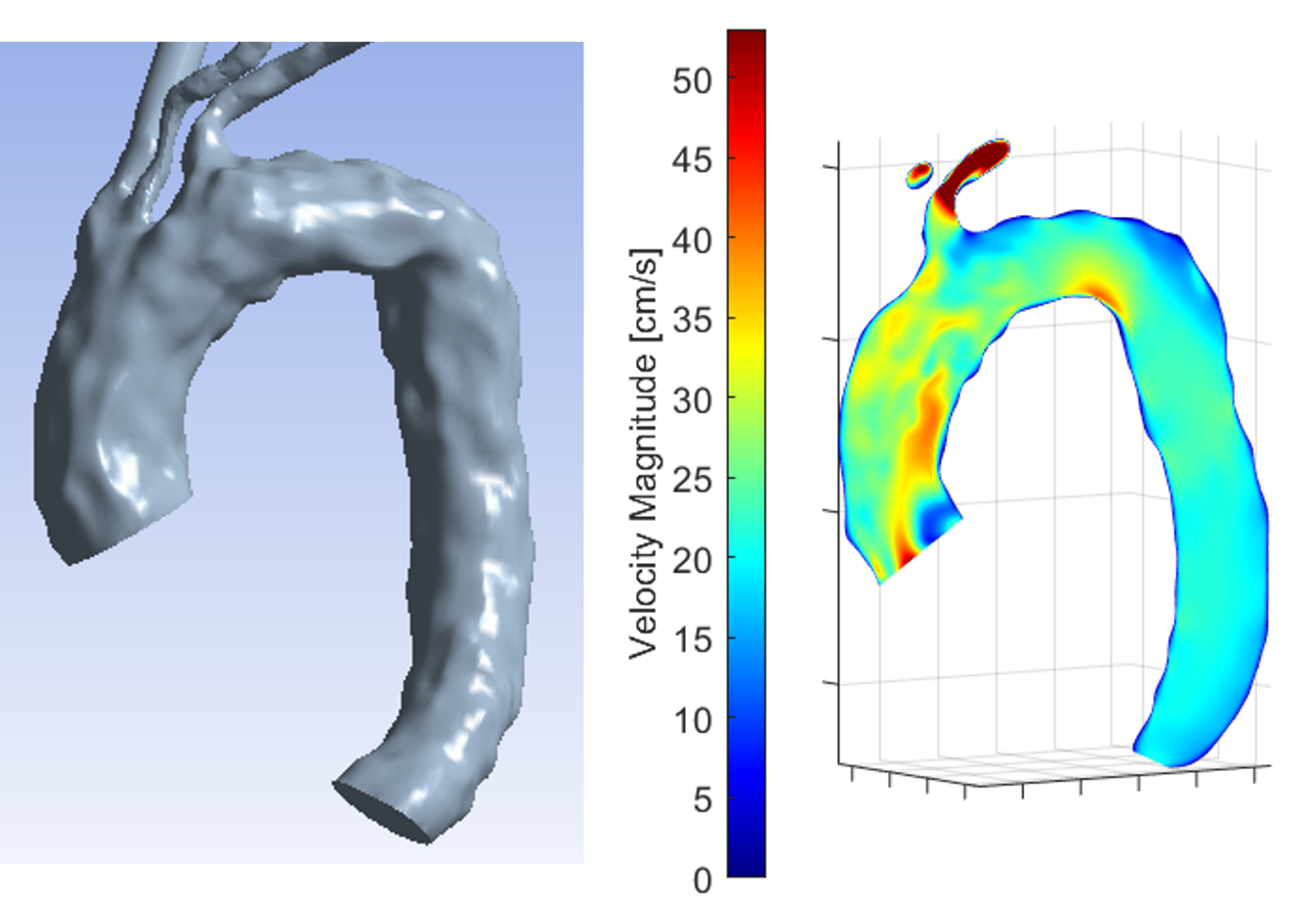 Left: Geometric model of the thoracic aorta. Right: Velocity field in a longitudinal plane
The criteria typically used in clinical routine to evaluate the progression of certain pathologies, such as aneurysms and/or dissections of the thoracic aorta, are not sufficiently discriminative to predict the best treatments early on. In this regard, the biomechanics team at IRPHE is conducting complex numerical modeling of these pathologies using data from medical imaging. However, the computation time associated with these models is a barrier to their use in clinical practice.
The main objective of this project is to implement deep learning methods, such as classic end-to-end approaches, PINNs, or DeepONets, to predict the progression of thoracic aorta pathologies.
One of the main tasks is to train a model capable of reproducing numerical results while reducing computation time, and to develop a model that can consider not only the information from a single patient but also from a representative set of patients, so that the model is not patient-specific. Additionally, we aim to identify which physical quantities are likely to be correlated with unfavorable disease progression, thus improving patient care.